Irakli Samelia
Tbilisi, Georgia
Swiss-Inspired 3D Motion Study
Project Overview
This project is a premium visual exploration that merges modern 3D motion design with a bold, minimalist Swiss-design color palette. The core focus was to experiment with complex mesh morphing, clean typography layout, and high-fidelity material rendering. By blending procedural 3D elements in Blender with dynamic 2D motion graphics in After Effects, the project achieves a sophisticated, conceptual aesthetic designed to push the boundaries of digital still-life animation.
Technical Breakdown & Workflow
Rigging & Morphing via Hook Empties
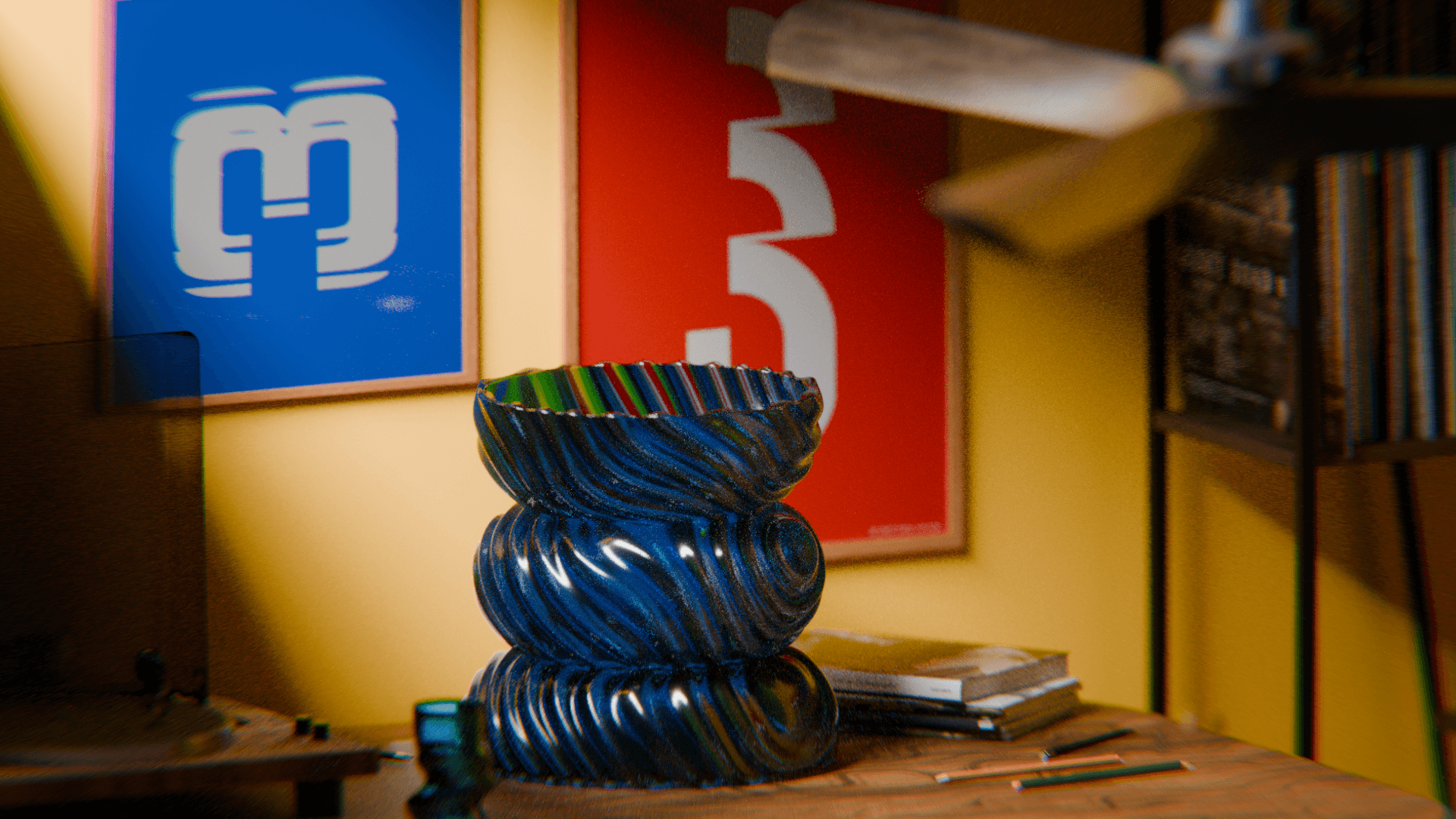
To capture the fluid, organic shape-shifting effect of the main vase mesh, I avoided standard shape keys and instead opted for a more procedural and controllable rigging approach:
I utilized multiple Hook Empties assigned to specific vertex groups of the pot's mesh.
By animating the transforms, scale, and subtler rotations of these Empties, I managed to dynamically drive the morphing effect without destroying the complex topology or twisting the spiraled grooves of the glass.

Texturing & Material Science
The scene relies heavily on high-end tactile surfaces to evoke a sense of premium physical fabrication:
The Glass Artifacts: Built using a custom layered Glass BSDF with subtle dispersion. The deep, rich blue tone reacts dynamically to the environment, creating intricate internal refractions.
The Studio Environment: A warm, photo-realistic wooden grain for the foreground surface contrasts against a clean, matte plaster wall. The lighting setup simulates a harsh, architectural shadow casting diagonally across the scene to frame the products beautifully.
Hybrid 2D/3D Integration (After Effects to Blender)
The framed poster on the wall isn't a static texture. To bring the environment to life, I designed a minimalist, bold 2D typographic animation in After Effects ("MOTION DESIGN") using sharp, Swiss-style grids and tracking animations. This composition was exported as an image sequence and mapped as an emission/diffuse texture inside Blender’s shader editor, accurately catching the realistic soft lighting and ambient occlusion of the room.

Challenges & Solutions
The Challenge: When animating the Hook Empties to warp the pot's mesh, the procedural UV coordinates began to stretch severely around the neck of the vase, causing the glass reflections to look distorted and unnatural. Additionally, rendering thick, refractive glass in Cycles with high-contrast lighting introduced severe sampling "fireflies" (render noise) and artifacts during the morph animation.

The Solution: To solve the texture stretching, I switched from standard UV mapping to an Object-Coordinate based texture projection, utilizing an un-deformed Empty as the coordinate anchor. This ensured the material characteristics stayed locked in world space while the geometry morphed through it smoothly. To eliminate the render artifacts and fireflies, I optimized the Cycles light path settings by clamping indirect light, disabling caustics where they weren't visually critical, and utilizing the OpenImageDenoise temporal pass to keep the motion vector clean without blurring the micro-textures of the wood and wall plaster.